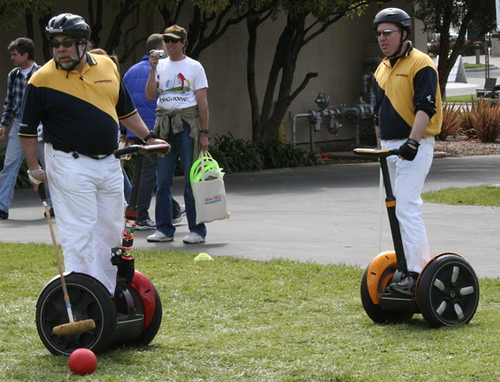
You may have heard how Jimi Heselden, the owner of Segway, died recently after tumbling off of a Segway.
The day of the accident, many Twitter posts reported this fact as “Segway inventor dies in Segway accident”. When in fact, this was not true: Dean Kamen is the inventor of the Segway, and had sold the company to Heselden and other investors earlier this year. Kamen is, assumedly, doing just fine.
I didn’t remember who actually invented the Segway; I had to look all this up on Wikipedia. But when I first read the news that “the owner of Segway died on a Segway”, I automatically assumed that it was indeed the inventor who had perished, until I re-read the headline twice, and began to wonder. I then confirmed that Heselden was the owner and NOT the inventor. I have not seen a news story about the accident that clarified this, though none explicitly made the false assumption, either.
So why did we all assume the inventor had died by the hands (wheels) of his own creation? Maybe it was an honest mistake. The Segway was unveiled in a flurry of speculation and hype, in which many predictions about the invention were made by other self-made inventors like Steve Jobs, who claimed it would be more significant than the personal computer. As this hype washed over us, the archetype of “the inventor” hung over this device, like Edison over the lightbulb, Einstein over relativity, and Jobs himself over a number of ubiquitous devices. A singular person had designed this wonder, and eventually we would celebrate him and his invention in the manner of these other “great men of history”. So when we hear the Segway has turned on its master, we assume that the robot has risen to kill its maker, not the current majority stakeholder in the first of no doubt several backing-capital turnovers.
But the mistake is not so honest. There’s something we like in this lie. There is a story we enjoy, so much so that we prefer the fiction to the fact. There’s something that completes an archetype. It’s not just the trope of technology destroying those who wield it. It is the Frankensteinian horror: the flesh of the hands that brought life into mechanical hands, hands that so artistically made objects into living things, being slashed to bloody bits by those cold metal fingers. The plot of Edward Scissorhands is an example, as is The Terminator Saga, and many other tales of industrialized pathos, the Fordian Doom bending back to poke us through the brain, to snap our twig-like limbs, and to crush our skulls under heavy metal feet. Not just destroying the world, but killing the maker himself (invariably, “him”-self). From ingenuity to invention, from dust to dust.
If you frequent Twitter, or certain circles of it, anyway, you might detect a subterranean desire for this particular sort of ironic pathos. Though it is clearly not just Twitter, but a feature of our current consciousnesses. Twitter only amplified this unconscious sentiment, 140 characters at a time. We cross our fingers and pray that the daily stream of bad news is some way ironic, or symbolic, or in other ways fitting to the overall tragedy of human existence. This is not the sort of thing we wish for out loud in polite company, but we all do it. We wish that the executives of BP would die in fiery fuel oil explosions. We hope that those who mock our beloved Internet become ill for not checking their symptoms via Google. Or at least those who refuse to admit the usefulness of 140 character messages end up being saved from rampaging mutated kittens by sending a SMS to emergency services. We wish that there was some sort of perverted justice in the world to take the place of regular justice that just does not exist.
And that is only the most defensible category of this urge for symbolic death. In the case of the inventor of Segway, there may be some angst towards an expensive device over-built in hype, but it would not fulfill anyone’s sense of justice to see the man perish at the hands of his own machine. It would merely make it more interesting. Such an end would conclude the bizarre chapter of human technological history that is the Segway with a larger-than-life meaning, a tragic symbolism worthy of Greek mythology, an almost Promethean demise in which an inventor gives something of great promise to the world under the best of intentions, only to have his breakthrough mocked, derided, accepted only by the most suburban of police forces and mall security squads, only to have it eventually be the very sword driven through his heart. This is the death we wished for Dean Kamen (at least symbolically), and gave to him undeserved through a sadistic, Freudian Twitter-slip.*
I’ve been trying to think of a name for this urge–this desire to make bad news more allegorical than it is. This morning, I think I came up with it: “Ballardianfreude”. The word “schadenfreude” comes from the German words “schaden” (adversity) and “freude” (joy). It describes the pleasure we gain from others’ misfortune, the joy in adversity that is not our own. J.G. Ballard was a master of modernist irony, describing in all its disgusting glory the oxymoronic pleasure we get from pain, the doom we find in technology that sustains our lives, and the beautiful trap we have built for ourselves out of this modern world. Inside, between the gnashing gears of our transmissions, lies the deep pleasure in the dirty oil, beneath the shining carapaces of bezels and dashboards, the gleaming exteriors shining with speed that will, after Ballard, always evoke their guts, and ours. It is with these eyes, that once opened to the sexiness of car crashes and the orgiastic organicism of overpasses cannot fail to continue to find these artifacts of apophenia, with which we seek out items to reinforce our Ballardianfreude. The only thing more uncanny than to find out we are all going to die is to discover that for no reason, some of us are going to live. Against the positive humanism that turned against us to castrate our dreams, we place the negative affirmation of Ballardianism, the reassurance of beauty and meaning in death. And in this deployment of Ballard’s themes, we in this age, find a certain joy.
And so we seek to find it. For every inventor, an untimely death. For every worldly success, a deep unconscious failure. For every dream made real, a thousand chained to the rocks, with their livers ripped out by ravenous carrion eaters every time the sun rises.
Of course, the pleasant upside to Ballardianfreude is that we are constantly disappointed. The world isn’t as dark as we see it, just as it isn’t as light as we’d like it. Reality is the constant fuzz of gray that a television displays when it is not tuned to a channel or to a pirate broadcast, but to the inherent noise-interference of the universe. A world of constant accidents, some comedic, some tragic, and some utterly meaningless. A man dies in a scooter accident. These things happen every day. The relief from meaning lies in its absence, the surreal reality of the possibility of patterns. Tomorrow there will be traffic accidents and bridges constructed, broken hearts and newly discovered dreams.
The true meaning lies in the sound and the fury. Something is, utterly, utter nothingness. Signifying that.
* Like the undeserved ire for Kamen, so suffers the Segway. I am equally guilty, simplifying the Segway to improve my story. While the Segway didn’t live up to the hype, it is a great tool for personal mobility, especially for the disabled. There are also many off-shoot designs for different purposes. If I live long enough to where my legs begin to fail me, I hope there is some easy device like this in existence that allows me to get out and continue to explore the world, while standing upright.
This post is one of the 50 Posts About Cyborgs, curated by Tim Maly. The series commemorates the 50th anniversary of the coining of the term, “cyborg”, with 50 unique instances of current thoughts and ideas about cyborgs, which are, it would seem to be proven, alive and well. I’m proud that POSZU could feature among them.
“The philosophers have only interpreted the world, in various ways; the point, however, is to change it.”
Theses on Feuerbach, XI
* * * * *
A cyborg is haunting the torrent networks of Europe, queuing files and running checksums. The saved files are in ebook format, and she syncs them to her handheld screen device. Meanwhile, she finishes a phone call, stands up from her desk, unplugs her device and put it in her bag. She shoulders the load and leaves to catch the train home. There, after eating, she will open her device, and begin to read.
Over mornings of mundane meetings, afternoons of spreadsheets, and finally, these evenings of critique, a pattern is developing. This cyborg is beginning to re-evaluate things. There was always a pattern; but it is beginning to shift. On this particular evening as she is annotating Merleau-Ponty’s Phenomenology and Perception with flicks upon her multi-touch screen, she can’t help but feel that pathways are slowly opening that had not been before. From the gestures at the tips of her fingers she summons these various networked texts of the flesh.
“…our body is comparable to a work of art. It is a nexus of living meanings, not the law for a certain number of covariant terms. A certain tactile experience felt in the upper arm signifies a certain tactile experience felt in the forearm and left shoulder, along with a certain visual aspect of the same arm, not because the various tactile perceptions among themselves, or the tactile and visual ones, are all involved in one intelligible arm, as the different facets of a cube are related to the idea of a cube, but because the arm seen and the arm touched, like the different segments of the arm, together perform one and the same action.”
Phenomenology and Perception, 175
It was all the rage on the social networks, to read these 20th Century works of theory and to highlight and link, to be involved in the asynchronous, continuous conversation about the modern, electronically augmented body. The philosophy was simple enough, ideas that conformed to the thoughts she already had. It was nice to read something theoretical as a break from the fiction, the news, the gentle critique of various musical artists, and so forth. On the surface of the multi-touch screen, guided by the subtle vibes of haptic feedback emanating from the words, she responded to the text.
“To know how to type is not, then, to know the place of each letter among the keys, nor even to have acquired a conditioned reflex for each one, which is set in motion by the letter as it comes before our eye. If habit is neither a form of knowledge nor an involuntary action, what then is it? It is knowledge in the hands, which is forthcoming only when bodily effort is made, and cannot be formulated in detatchment from that effort.”
Phenomenology and Perception, 166
The cyborg had tried an obsolete “keyboard”; it wasn’t much different than the adjustments made in one’s typing habits when installing a new multi-touch predictive text algorithm. She tapped and quietly vibrated away, flicking and pecking at the screen. This part of the text was all about body image, or a certain lack of body image. This text, a guided reflection on the structure of consciousness and the perceptions, plugged several compatible ideas into this cyborg’s thought processes.
“A woman may, without any calculation, keep a safe distance between the feather in her hat and things which might break it off. She feels where the feather is just as we feel where our hand is.”
Phenomenology and Perception, 165
This particular cyborg had hefted more hammers in her hand than worn hats with feathers, but the idea was easy enough.
“We must therefore avoid saying that our body is in space, or in time. It inhabits space and time. If my hand traces a complicated path through the air, I do not need, in order to know its final position, to add together all movements made in the same direction and subtract those made in the opposite direction. ‘Every identifiable change reaches consciousness already loaded with its relations to what has preceded it, as on a taximeter the distance is given already converted into shillings and pence.’”
Phenomenology and Perception, 161
She stopped her typing, her synthesis of copy and paste, and lifted her fingers from the surface of the screen, and brushed the hair back from her eyes. Shillings and pence. Keyboards. Hats with feathers. It was cute, in a way. The nostalgia one could experience, through such old, written, static texts. Non-wiki philosophy. Like riding in a horse-drawn carriage—following wherever the horse decided to go, pretending you were driving, rather than being dragged by a roped and shackled live animal.
But this text was reminiscent of something, other than history lessons. The experience of the body, inhabiting space and time as a nexus of sensory relations. She was the good cyborg, conscious of her body and its feedback networks. She tracked her weight and blood sugar, her Circadian rhythms, her networked emotional and social capital. But this philosophy spoke to a lurking, intellectual category: some sort of logical thought feedback, perhaps. There was an idea here–an idea about ideas–something she had a memory of reading before.
She checked her ebook ratio credits, and made a quick download. There was something she wanted to check. With a quick swipe-and-search, she found what she was looking for.
“A commodity appears, at first sight, a very trivial thing, and easily understood. Its analysis shows that it is, in reality, a very queer thing, abounding in metaphysical subtleties and theological niceties.”
Capital, 76
She hadn’t read anything by this author since early high school, when one kept such things in their Favorites queue to impress the social networks. Even so, it was hard to completely forget the Commodity. It was the star of this massive tome—the total annotated file surpassing most books by several megabytes. Nothing compared to a video file, but still relatively monstrous. And yet despite this verbosity, the Fetish of Commodities was ever so quotable, succinct to 140 characters. Even if the ebook itself was a status matrix inflater, there was something else in the Commodity that she could feel, a response within her to something she couldn’t quite identify.
A Commodity was, too, a nexus of living meanings. They were utilized as symbols of value, “human labor in the abstract,” she saw on page 51. They were in this way two-fold, “both objects of utility, and depositories of value,” page 54. Through the action of labor, meaning was tied to the object, so that it might be traded for other meaningful objects. And so, the object had meaning within society. If she remembered correctly, the bearded fellow whose picture was visible in the metadata window strongly Disliked.
“The product of labor is labor which has been congealed in an object, which has become material: it is the objectification of labor. In the conditions dealt with by political economy this realization of labor appears as loss of reality for the workers; objectification as loss of the object and object-bondage; appropriation as estrangement, as alienation.”
Manuscripts of 1844, 71-2
That was from another work, same author, annotated via hyperlink. A good edition, this—plenty of links to the body of work by the author, or at least those pieces for which the e-publisher had co-attribution rights. The major keyword in the word cloud for this text, hovering over it as she held a finger close to the screen, was “objectification”, nearly as large in size as “alienation,” and “estrangement.” Via the objectified nexus of values—the Commodity—the worker was as divided from her product as the product was separated from the world. A broken body, perhaps—or an amputated limb. Merleau-Ponty had plenty in his text about “alien limb syndrome”. She made herself a Task to remind herself to Wikipedia the current psychological research on the phenomenon later.
What did that really mean, “objectification of labor”? It sounded nasty, exploitative and industrial. A term suited to the economy and philosophy of 1844. But today? She flicked the screen-view a bit further down the page.
“The worker can create nothing without nature, without the sensuous external world. It is the material on which his labor is manifested, in which it is active, from which and by means of which it produces.”
Manuscripts of 1844, 72
Was that a bad thing? To make anything, one had to cleave off a little bit of nature, to pull off a hunk of clay, and mash it into something recognizable. She tried to think of the daily spreadsheets for which she toiled in this perspective; but that was depressing, so she stuck to the clay. Sure, life was no picnic. It was a constant struggle to survive, to do enough to be happy, to earn enough to rent an apartment, to afford a transportation pass to get to work. It was hard to say that this struggle was fulfilling, but that was the fact of life.
“In estranging from man, nature, and himself, his own active functions, his life-activity—estranged labor estranges the species from man. It turns for him the life of the species into a means of individual life. First it estranges the life of the species and individual life, and secondly it makes individual life in its abstract form the purpose of the life of the species, likewise in its abstract and estranged form.”
Manuscripts of 1844, 75
She thought about editing a text-mask to substitute “she” and “human” over this 1844 prose of “man”, but left it alone, lost in thought. Alienation in objectification might be depressing, or even exploitative, she figured (as she resisted the sudden compulsion to check her work email). But it was also a metaphysical necessity. Without objectification, things would remain part of the undifferentiated expanse of the sensuous external world. Without the objectification and attachment of meaning, how would anyone relate to things? This was the meaning of life as an individual. Even on Twitter, each person was identified by a unique user name, isolated by his or her own thoughts, own posts, own location, own follower count. Following was asynchronous. Even as everyone was together and social, everyone was alone. That was the fundamental principle of human consciousness, wasn’t it? Not bees, not a wolf pack, not a bacteria colony. Everyone united in space and time, everyone connected to the network, and yet everyone an individual, by the basis of each being its own node. The work that each did in forming meaning and value, whether in pottery or in the most mundane of status updates, both uniting and dividing the entire species. Each alone, and also part of the network of meaning.
She selected the link that highlighted the phrase “life of the species”, and a new tab opened. A new text.
“The first premise of all human history is, of course, the existence of living human individuals. Thus the first fact to be established is the physical organization of these individuals and their consequent relation to the rest of nature. […] Men can be distinguished from animals by consciousness, by religion or anything else you like. They themselves begin to distinguish themselves from animals as soon as they begin to produce their means of subsistence, a step which is conditioned by their physical organization. By producing their means of subsistence men are indirectly producing their actual material life.”
The German Ideology, 149-50
Marginal text notes identified this as “the first fundamental condition of history”. These fundamental conditions paved the way for the objectification of the nexus of meaning in commodities—in other words, a history of humans and their objects. Summarized in the notes: “Materialism: an individual naming specific needs is a material, linguistic act, separating the individual from the ecosystem in descriptive history”. This was the first historic material act: to call a piece of food a “fulfillment of a need”, and to seek means to acquire it. The beginning of the “I” statement, the ego’s historical self-description, is “I need…” The beginning of material identity.
“The nature of individuals thus depends on the material conditions determining their production. This production only makes its appearance with the increase of population. In its turn this presupposes the intercourse of individuals with one another. The form of this intercourse is again determined by production.”
The German Ideology, 150
This was the second fundamental condition. A human could not be an individual in a vacuum. There were other individuals about, and as they each described their labor as the satisfaction of need, their needs would split and divide them, or coalesce and unite them. What else do people talk about really, other than what they need, and what they want?
“The relations of different nations among themselves depend upon the extent to which each has developed its productive forces, the division of labor and internal intercourse. This statement is generally recognized. But not only the relation of one nation to others, but also the whole internal structure of the nation itself depends on the stage of development reached by its production and its internal and external intercourse. [...] Each new productive force, insofar as it is not merely a quantitative extension of productive forces already known (for instance the bringing into cultivation of fresh land), causes a further development of the division of labor.”
The German Ideology, 150
Third: as they talk, they begin to organize. They create divisions and unions. They work together, or against each other. The intercourse begins with conversation, but finds its true expression in society. Between nations, and inside nations. They might call this a post-national world, thought the cyborg. But nations are only a sense of belonging acted out in real life. Individuality as part of the group. Selecting a need, and calling it your own. Voting with javascript. Political opinion as a Retweet. Facebook had only been able to declare sovereignty from international law, years ago, because people kept using it. You couldn’t argue with a sheer mass unique users. Individuals organized into groups was politics.
“The various stages of development in the division of labor are just so many different forms of ownership, i.e., the existing stage in the division of labor determines also the relations of individuals to one another with reference to the material, instrument, and product of labor.”
The German Ideology, 150
The fourth fundamental condition of history was ownership. Being able to say that within the rules of the discourse of society, certain needs and responsibilities belong to certain individuals or groups of individuals: the ultimate self-expression of a group of individuals and their needs.
It was a bit disparate, perhaps. Reading the summary of the text, it felt like these four bullet points might be a bit of a jump. But as she stretched out her feet on the couch, she reflected on her body, her nexus of meaning. As she made herself, she was commodity, making other commodities. A body pulling of chunks of nature, and defining them according to the work she did, to the needs she wanted satisfied, to the societal meaning for which these commodities could be exchanged for others’ satisfaction. Her needs, and others’ needs—both defined through the discourse of society. The discourse of history. It wasn’t a primal scene, these four fundamental conditions. They were a matrix of facts, each a facet of the crystallization of history. If the human species was going to describe its relations with nature, and if the human species was going to describe itself, she supposed it would have to start here. The relationship with nature was built on this discourse of needs. And the discourse was constantly re-interpreted via this material relationship. The relationship became Society.
Now she felt she was getting somewhere, though she wasn’t sure where it was. Bodies and needs. Nature and society. All tied up with a network of meaning: objectified and cut off, organized and extended to solidify social bonds and identity. But networked nonetheless. She felt more comfortable with the metaphor of the network, for some reason. It seemed familiar, and accessible. It was something she could see, stretched out to the horizon in front of her, an image of silver threads crossing and knotting, circulating in nodes of objectification and individuality, and shooting back from where they came. Pulling things together and pushing them apart. Just a metaphor, perhaps, but she felt she was beginning to understand.
But something left her a bit unsettled. The last fundamental condition: ownership. The jewel in the crown of objectification, and the main character of the discourse. The text said that division of labor was a form of ownership? Today, her society didn’t seem to find its self-expression in ownership. At least not most people. She owned things, everyone did. But it didn’t seem as vital as the old man implied. Maybe in the 19th century or the 20th century ownership always led to material inequality and objectification. But now? She didn’t seem to really own any of the things that were important to her. Technically, if anyone ever asked, she owned her clothing, her electronics, and her bike. But what did that mean? It seemed like she only owned them out of convenience. Because everyone else had them, and so she had her own. Ownership just meant she didn’t have to share.
Of course, if she left her touch device on a subway bench, someone would scoop it up. It wasn’t that there were enough of these things for everyone to have one. And, come to think of it, she wouldn’t even like to share her device. It was customized to her preferences, it had learned her typing style and the weight of her touch, the speed of her double-click. If someone else used it, it would screw it up. Right now, it satisfied her need, but if she had to share, she supposed it wouldn’t. Or at least, not as well.
She realized she had been scrolling idly, and stopped, suddenly focusing on a paragraph in the text.
“Division of labor and private property are, moreover, identical expressions: in the one the same thing is affirmed with reference to activity as is affirmed in the other with reference to the product of the activity.
Further, the division of labor implies the contradiction between the interest of the separate individual or the individual family and the communal interest of all individuals who have intercourse with one another. And indeed, this communal interest does not exist merely in the imagination, as the “general interest”, but first of all in reality, as the mutual interdependence of the individuals among whom the labor is divided.
And finally, the division of labor offers us the first example of how, as long as man remains in natural society, that is, as long as a cleavage exists between the particular and the common interest, as long, therefore, as activity is not voluntarily, but naturally, divided, man’s own deed becomes an alien power opposed to him, which enslaves him instead of being controlled by him.”
The German Ideology, 160
She had to read it twice, but she finally began to get it. The family was, the old man accused, naturally selfish. It was natural, of course, for members of a family to seek to protect each other and their collective needs, as opposed to all the other families out there doing the same thing. Genetics, natural selection, altruism as evolutionary fitness, etc. But as society developed, eventually the family would become obsolete. The needs of certain individuals would be better served by not relying on the old institution of family, and they would break away. New institutions, like the city, would rise. The country. Class. These patterns of social intercourse would network the division of labor and division of need according to what would best serve them, and what would best perpetuate them. Sometimes it would work in the general interest, sometimes not. But this division of labor was a system of ownership, not just the ownership of particular objects. Whether the pathways of social meaning and the material fulfillment of needs were sculpted by a class or by a family or by an individual to protect themselves, it was a social network, meant to perpetuate itself in a historical feedback loop. “Ownership” of a commodity was a node of social intercourse that sought to solidify itself within the object and its meaning. She identified her touch device as her own, to help her remember not to leave it on the subway. In a way, that someone might take the device if she left it somewhere also served to reinforce the link between the device and herself. It it was not socially desired, she would probably lose it all the time, just like one of those old paper magazines. The magazine didn’t lose its value—it just became more valuable as recycled paper pulp than as reading material as societal need shifted.
Times changed. It seemed in the old days the need for ownership was a much stronger drive. This text predicted a state of world-wide destitution, which just didn’t seem possible today. Scarcity was less common, even though it still existed. People were still starving, and it seemed that only the rich were getting richer. But the idea of most people not being able to fulfill their basic needs seemed like an ancient problem. Was it because she had enough that she didn’t care about ownership?
The family was archaic. She loved her parents, and video chatted with them all the time. But now all education was available free on the network. All living quarters were, at least for the vast majority of the population, about the same cramped size. So leaving home hadn’t been a right of passage, like her parents always referred to it. “Teenage”, they used to call it, the time when you were an adult but still needed to be part of a family. The time when your needs were best fulfilled by including your ownership with a family’s division of labor. But those times were gone.
The social pattern and system of ownership about which people felt emotion these days was “the commons”. People were always defending the right of the commons, defending people’s access to the commons, complaining about the erosion of the commons, or attacking someone else’s idea of what the commons was supposed to be. Common or not, it was still a form of ownership according to this text. By enforcing the idea that certain media, resources, and pathways of access were universally accessible, their value was artificially held at zero, a level at which it was supposedly “owned in common”. People used to pay money to exchange books, music, education, and network access. Now cultural objects only had social value–commodities stripped of all but a universalized, general value. The pieces of the commons had no exchange value, and so all value was subordinated to the value of society’s system of ownership, as a whole. The whole–the commons. It was a feedback loop that reinforced its own meaning, just like the family, or any other social division of labor defined by the fundamental conditions of history.
The cyborg was hardpressed to think of exactly what matrix of human needs this networked organization of value protected—but it was a division of labor, nonetheless. It divided everyone from themselves by pushing them together into a mass. Everyone was a mass-contributor/mass-consumer. If you were against the commonality, and tried to retain any individuality over media ownership, you were boycotted. If you were not part of the commons, then you might as well not exist. The commons was the only form of ownership for cultural commodities, and the only form of meaning to the network.
It wasn’t too different from what the Singularists had preached, though they had pretty much abandoned their religion when it became apparent that not only was connecting human minds much more complicated a task than they expected, but that most humans didn’t want to be linked together, at least not with most of the rest of humanity. And yet, that idealist attempt at unification of the spirit, the humanist urge to push the species into an undifferentiated mass, had lived on in the commons.
The cyborg had never really thought about it much before. She didn’t consider herself a creative, and just downloaded music and books as she liked, and as her ratio credits allowed. But now, thinking about it in these terms, she began to feel a bit of what she guessed was… anger. They talked about the triumph of human consciousness in the commons—the sum and maximalized synthesis of all human creativity. Humanity as humanity, they said. The ultimate self-consciousness in the freely available sum of all production.
But that’s not what it was at all. It was just another way of organizing society. Just another means of ownership, controlling the way things were produced at the expense of those who produced them. No one was an individual in the commons. They acted as if it was democratic, but it was no more representative than an ocean was to a drop of water. This was just a singular, chaotic class, into which everyone was poured, and out of which they would never be distilled.
“The relation of the productive forces to the form of intercourse is the relation of the form of intercourse to the occupation or activity of the individuals. [...] The conditions under which individuals have intercourse with each other, [...] are conditions appertaining to their individuality, in no way external to them; conditions under which these definite individuals, living under definite relations, can alone produce their material life and what is connected with it, are thus the conditions of their self-activity and are produced by this self-activity. [...]
These various conditions, which appear first as conditions of self-activity, later as fetters upon it, form in the whole evolution of history a coherent series of forms of intercourse, the coherence of which consists in this: in the place of an earlier form of intercourse, which has become a fetter, a new one is put, corresponding to the more developed productive forces and, hence, to the advanced mode of the self-activity of individuals—a form which in its turn becomes a fetter and is then replaced by another. Since these conditions correspond at every stage to the simultaneous development of the productive forces, their history is at the same time the history of the evolving productive forces taken over by each new generation, and is, therefore, the history of the development of the forces of the individuals themselves.”
The German Ideology, 195
She read that, and then put down her device. She felt, suddenly, very empty. She thought about work, about the commute there and back every day. About the endless cycle of meals she ate, about the endless chain of downloads she consumed. About the endless calendar of days, one just like the next, as she slowly grew older. As history unfolded itself—and looked more and more the same as before.
Where was the art? That artful, next of meaning that was supposed to be her body, and her network of valuable experiences? In the commons, she was bankrupt. Not so much empty, as rendered valueless. She wanted to feel something mutually-interdependent, to feel transactions of value. She wanted to experience meaning, passing through her network, and into others’. She wanted to make something. She needed to really consume something, to use it until it was gone. She wanted to feel the reality of need, to experience it with other producers, and to share the mechanism of that need’s satisfaction between them.
She put down her reading device, and after finally searching through drawers and across tables, found the means of production she was looking for. She sat down, seized the pencil into her fingers, and began to draw.
“…it is clear that the real intellectual wealth of the individual depends entirely on the wealth of his real connections. Only then will the separate individuals be liberated from the various national and local barriers, be brought into practical connection with the material and intellectual production of the whole world and be put in a position to acquire the capacity to enjoy this all-sided production of the whole earth (the creation of man).[…]
This conception of history depends on our ability to expound the real process of production, starting out from the material production of life itself, and to comprehend the form of intercourse connected with this and created by this mode of production [...]
…It shows that history does not end by being resolved into “self-consciousness” as “spirit of the spirit”, but that in it at each stage there is found a material result: a sum of productive forces, a historically created relation of individuals to nature and to one another, which is handed down to each generation from its predecessor; a mass of productive forces, capital funds and conditions, which, on the one hand, is indeed modified by the new generation, but also on the other prescribes for it its conditions of life and gives it a definite development, a special character. It shows that circumstances make men just as much as men make circumstances. This sum of productive forces, capital funds and social forms of intercourse, which every individual and generation finds in existence as something given, is the real basis of what the philosophers have conceived as “substance” and “essence of man”…”
The German Ideology, 165
The device auto-scrolled without any touch from the cyborg, down past the quote even as she ignored the words rolling past, focusing on her piece of paper and the spreading gray lines that emanated from the tip of her pencil, from the ends of her fingers, from the turns of her wrist, and from the syntheses of her mind. Without input from her, the screen quietly faded to battery-saving mode, its soft light less and less of a presence in the room, before finally going completely black. Just another object now, faded from the cyborg’s area of perception. Old-fashioned typewriter keys pounding into the air, imprinting on nothing.
Works Cited
Phemenology of Perception, by Maurice Merleau-Ponty. Routledge, London and New York: 2004. Capital, Volume One, by Karl Marx. International Publishers, New York: 2003.
“Theses on Feuerbach”, by Karl Marx. In The Marx-Engels Reader, Robert C. Tucker ed. W.W. Norton & Company, London & New York: 1978.
“Economic and Philosophic Manuscripts of 1844”, by Karl Marx. In The Marx-Engels Reader, Robert C. Tucker ed. W.W. Norton & Company, London & New York: 1978.
“The German Ideology”, by Karl Marx. In The Marx-Engels Reader, Robert C. Tucker ed. W.W. Norton & Company, London & New York: 1978.
This is a tech post. If this isn’t your thing, click away now.
Furthermore, this is not just a tech post, but a personal musing on my own personal tech. So if you don’t want to hear me talking about my own computers, definitely click the heck out of here.
But in the end, I arrive at a sound and reasonable argument for switching your operating system to Linux. So if you are the sort of person who has not yet switched to Linux but might eventually be plied, or are at least interested in what sort of argument may or may not get you there, then read on.
- Time to Change the OS Oil
My Dell Inspiron 6000 laptop recently encountered a new string of problems. Something to do with deprecated video games install procedures and a resulting fatal error with Direct X that could not be fixed even with some registry noodling and several complete re-installs. So, I was going to at least be re-installing Windows XP to fix video.
Which I’m fine with, because the computer is 5 years old and never had an OS re-install, even through a replaced motherboard, a new screen, and all of the abuse that the system has taken. This is pretty typical for the computers in the house. I like fixer-uppers, and have always been frustrated by people who lose a DVD drive or mess up their Wifi settings and go buy a brand-new computer. Computers are so easy to fix these days, and while my 1.75 Ghz Dell isn’t fast, it totally gets the job done. In addition to the Dell, we have a old AMD machine Frankensteined from spare parts that is our NAS server (running Openfiler, a NAS-centric Linux distro), a sub 1-Ghz Dell box “rescue dog” I use for testing hardware, my partner’s old G4 Powerbook running OSX 10.4, and her new EEE PC that is hers and that I’m not allowed to mess with. Because I like to screw around with computers, even if I don’t always know what I’m doing.
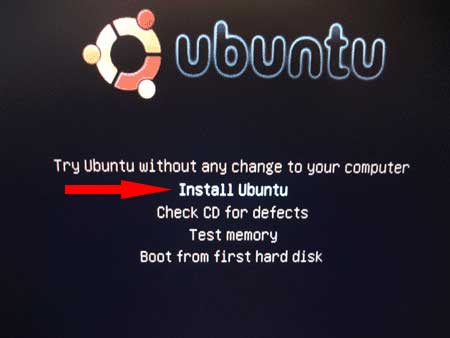
So, why I was digging out the OEM discs that amazingly, I saved through 3 moves, I thought: hey, I’ve always wanted to try out Ubuntu on a primary machine. What better opportunity than now to try a dual-boot with XP? I always back up my data on the NAS, and I’m going to F-disk the laptop anyway. The worst thing that happens is that I have to start from scratch twice. I’d heard good things about the latest version of Ubuntu, 10.04 (Lucid Lynx). So let’s start another nerd project, shall we?
So, two weeks in, here are my reflections on this experiment.
- A Free Operating System
All the sources say to install your XP first, and then Ubuntu, because XP’s boot loader will wipe out Ubuntu’s if done the other way around. So I installed XP from the OEM disc. Took 20 minutes or so.
Let me tell you, there is NOTHING there. NOTHING works. No hardware drivers, no programs. No internet connection, because XP will not natively work with my network cards. I see a field of grass and a blue sky, and that’s it. There should have been a separate disc from Dell that had all of this stuff on it, but I lost that one. So I was looking at a very nice desktop, but nothing else, until I retrieved the drivers from another machine and brought them via a USB key to this machine, and managed to get on the Internet.
It is very interesting to have a computer with no functional Internet connection. Kind of like being on a deserted island. Anything that you will need to fix your Internet connection, you will have to get online. A computer without an Internet connection isn’t really a computer these days; it’s more of a calculator with a large memory. You can enter data into it, but it isn’t going anywhere or doing anything other than bouncing around. The only programs that you can load are programs you enter into it, manually, as it were. Especially when a program requires update X or other utility Y, because you are not just clicking OK, download/install, you are taking a USB key across the house to the other computer, finding and downloading executables on the Internet, bringing them back, and then installing, finding you need something else, and going back again. Kind of like fighting a fire with a one person bucket brigade.
So I decided to leave XP alone for a while, and try out Ubuntu. I’m not going to lie and say it was seamless–I actually had to install it twice. The first time I installed 9.14, and then upgraded to 10.04 via download. But, I accidentally shut down the computer while it was upgrading. It finished after I started back up, and seemed to work at first, but then started crashing and dropping network connections. Also the software update utility got confused, and rolled back a lot of updates. So I reinstalled the whole Ubuntu partition with 10.04 from a mounted USB drive. The second time, when some idiot didn’t unplug the computer, it worked perfectly. So I chalk that first try up to (serious) user error.
The first thing I noticed when I booted up Ubuntu for the first time (correctly) is the thing no one else says about Ubuntu, and it’s best trait. Not that it “just works”. Not that it actually looks good. Not that it comes with drivers and software pre-installed.
It is a free OS. And this means that you get all of the above.
Here’s what I mean. I updated my iPhone 3G to iOS 4, and got many problems, along with the rest of the world, because the software update was meant for the new hardware Apple was selling, not my 2-year old piece of smart phone trash. It was, in a sense, backported to my hardware with limited features and many flaws.
When I re-installed XP, the operating system I paid for with my computer, it was almost unuseable. This is because it was designed to be sold by an OEM, in this case, Dell. Dell would sit with my computer, and make sure the network cards had drivers, install relevant or useless software for me, and basically turn the bare bones of XP into a usable operating system for a consumer.
However, Ubuntu neither makes a free OS as a way of selling hardware, nor sells their OS to hardware manufacturers and distributors, who are responsible for hooking up all the leads. Ubuntu produces a free OS, meant to be downloaded and installed on any and every (pretty much) computer out there. It is a complete package, and must be. It is complete because it is a product, albeit a free product, on its own. It can only be on its own as a product, because it is free. (The only people who sell versions of Linux sell it tied to service or hardware).
Additionally, Canonical (the people who organize and distribute Ubuntu) make a substantial release every six months. Among other reasons, they do this to keep it fresh, and to keep it updated, and to keep it: canonical. When I finally got my drivers and connected XP to the Internet, it took five reboots and OVER NINETY DOWNLOADED UPDATES until XP was “current”. Those are serious updates, that fix security flaws or other operational problems. But all I had to do for Ubuntu was to install the current version. One version to improve them all: canonical. Apple makes their software the same way–you install the new OS version. Except that it fucks up your phone as a surreptitious way of convincing you to buy new hardware, or in the case of our G4 Powerbook, we CAN’T install a new version. Not without paying for it.
But Ubuntu is a free OS. So every six months, you are installing a brand-new OS, that is complete. In my opinion, this is the predominant reason that opens-sourced OS, in this sort of canonical distribution format, will eventually displace other OS. The universality and the completeness can’t be beat. Imagine, for example that every person who has a new car, has a closed OS–but every person who has a used car runs Ubuntu. Most people own new computers. But when there is an alternative, there will be drift. Ubuntu is that complete functional alternative. It represents the possibility of a used car market. For me anyway, it saved me buying a new laptop.
- Free Software
Along with the canonical distribution system, comes the wealth of free software. Again, this is much more than the simple “it just works” tag line. Yes, there is software pre-installed. But there is also a lot of software that is easy to get. And it is easy to get in a way unlike any other OS.
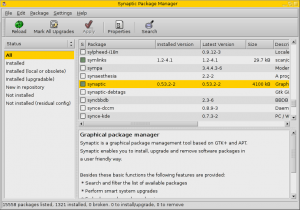
I first tried Ubuntu a little over a year ago, and as a noob, I didn’t really get the Synaptic Package Manager. I think many Ubuntu users take it for granted. But it’s brilliant. If you’ve ever installed software on a Mac, its similar, at least in principle. All software comes in pre-recognized packages, and then this package is mounted and automatically installed. But Synaptic Package Manager makes it super easy. Because all the software is free, it can be accessed via various “Software Sources”. You plug in your Software Source, not unlike adding an RSS feed to a aggregator, and then via the Package Manager you can search and install software with a couple of clicks, without dragging anything to the desktop, without mounting anything, and without having to come back and look for individual updates. The Update part of the Package Manager lists all of your software, and automatically check for what updates are available, and checks if anything has been made unusable by OS updates.
It’s reminiscent of an app store, and even more so with the most recent Ubuntu release, which actually has a software browser designed like an app store, listing all software you could possibly download in categories by function, (music, utilities, etc) with screen shots and descriptions. No reviews yet. But did I mention it is free? And with the Package Manager, trying new software is as easy as plugging in a pair of headphones. None of that Windows registry garbage, piling up traces of old programs, slowly junking up the system. As far as I know, anyway. I tried just about every music player program available for Ubuntu trying to find the one I liked best, because I’m finicky like that (Media Monkey, please go to Ubuntu! Best music player UI, IMO).
And there are replacement possibilities for just about everything. Before re-installing Windows, I made a list of every program I used. I already used Open Office in XP. I do miss Media Monkey, but mostly because of the UI. Rhythmbox is totally equivalent (and better) than iTunes. You can even buy music in Rhythmbox. VLC is equivalent to any video player. Some people say better. I used Firefox and Chrome in XP, I use them both in Ubuntu. Evolution email looks comparable to Outlook, but I stick to web apps for stuff like that regardless. I used Picasa in XP, I use it in Ubuntu. Haven’t tried GIMP for image editing yet.
Things I can’t use in Ubuntu include games, Adobe CS, and iTunes. But this is why I set up the dual boot. Which was easy, by the way. Ubuntu will automatically set up a boot screen giving you the option of Ubuntu or Windows when installed in a partition separate to another OS install. Even so, the only times I’ve been in the XP partition over the past two weeks have been to do chores, trying to get XP working. Day to day computer use (web, video, music) has all been comfortable and seamless in Ubuntu.
- Hardware
I already compared the driver experience in Ubuntu to a fresh OEM install of XP. I’d say that Ubuntu is in full bloom when it comes to hardware support. Almost everything works automatically, because they’ve swept up most drivers and put them into the canonical distribution. There are still rare exceptions, that take some custom tweaking to make it work (though you CAN make it work, if you spend the time, whereas with other systems, if it doesn’t work, you are SOL). Everything I’ve read by tech-folks say that Ubuntu is over the hump as far as hardware support goes. Ubuntu is big enough, and there are enough people working on it, and enough hardware manufacturers are freeing up the documentation that the vast majority of stuff you would plug in to your machine works already, and the rest is getting roped in.
Performance is a little slower. Just a little. I notice a little bit of difference in video playback between the former install of XP and Ubuntu. I may need to tweak a setting on the video codecs. Or, it may be that I run too many intensive processes simultaneous (I’m always converting media file formats, or ripping discs, or something). Or it might just be that my video card is five years old, and my processor is only 1.75 Ghz. Anyway, it is more than serviceable for restoring an old computer, and probably perfect on a computer with some better stats. And everything other than the video is perfect–even the hardware accelerating desktop effects (rubbery windows when you drag ‘em around) works seamlessly.
There is one hardware accessory that I can’t get to work correctly, but I’ll talk about that next.
- Freegan Ire
I’ll come right out and say yes, I have a certain political support for open-source. I am that sort of techno-anarchist, and kind of a tinkerer with computers. And generally anti-capitalist. But aside from all that, I like my technology to work. I waited in line to buy an iPhone 3G, because I knew it was going to be good. I like technology that does things, and does them well.
So I like Ubuntu, because it does things well. And while it might be my bomb-throwing freegan ire that makes me angry at hardware manufacturers that specifically spurn open-source, it is also my sense of quality. Ubuntu is a viable OS, and a widely-used product with a history and a future. It should be treated as such.
So when my iPhone refuses to sync music with Ubuntu, it makes me angry. I waited in line to buy this thing, because I knew it was a good product. But because Apple makes it so you MUST manage media content via iTunes, and because they ONLY make iTunes for Windows and Mac, and because the phone WILLFULLY refutes attempts to access its media content from other programs, they are giving all Ubuntu users the finger.
Okay, I know the phone is not willfully doing anything. But it seems that way. With Rhythmbox you can, supposedly, sync music to the iPhone. Ubuntu mounts the iPhone, it shows up in Rhythymbox, and I can even drag music to the icon, and music will transfer to the phone. I know it is on the phone, because if I open the mounted file system of the phone, I can see the music files. But they will not be visible on the phone via the iPod. It has something to do with a file called iTunes.sync.lock or something like that, because taking advice from the Internet, I deleted that file from the phone, and then music synced perfectly, just like it had been put there with iTunes. But then, the phone restored that file with no input from me. All the music that had been visible via the iPod disappeared, even though it is still on the phone’s file system.
Although my technological knowledge is limited, I can only assume that Apple is purposefully making it difficult to access the phone media via anything other than iTunes. I take as evidence the fact that there are no other programs, open source or not, for ANY OS that will sync to an iPhone. You can sync to iPods and to other media devices, using any number of programs, but not iPhones. It is not a straight-up incompatibility, because I got it to work, at least for a time. But the phone disabled that syncing ability, even after it was already working.
Anyway, I’ll cut it short and say I’m pissed, and this is the first time I’ve ever seriously thought about rooting my iPhone, and one more brick in the wall of my-next-phone-will-be-Android. (Not because an Android phone works better with Ubuntu/Linux, but because an Android phone works WITHOUT iTunes.) Also, there is a saving grace to this problem, which is the next section. I have faith that the legions of the Ubuntu volunteer tech-support and development will eventually crack the iPhone, and make it work. Because they are my heroes.
- Service
There are many companies that have a successful business model in providing service for Linux. And why not? If you are a business, why not take all the money you would spend on software without support, and invest it in great support for free software? With the customization available with Linux, it seems like a no-brainer for any small business with specific IT needs.
But even for us rage-filled freegans, the service aspect of Ubuntu is fantastic. I, and perhaps you, are members of the Google age. When we have a problem, the Internet solves it. And when it comes to computer questions, and moreover, OS questions, there is no better, bigger, and more searchable repository of knowledge and volunteers than Ubuntu Forums.
The reason of course, is because Ubuntu is volunteer made. Without these contributors, it wouldn’t exist, or have evolved to be a reasonable OS alternative for casual/power users like myself. Ubuntu has needed these people to make it usable, and now they are a free resource that comes along with a great OS. I’ve never once had to ask a question on the forums, because by searching I’ve found every question I’ve ever wanted to ask not only already asked but answered. Ever have any luck finding something in Microsoft Knowledge Base? Yeah.
Now, this isn’t to say it is a total breeze. If you want to use Ubuntu, or any form of Linux, you should be prepared to lift the hood. No, you don’t have to, but you probably will want to. And for the inexperienced user, the notion of a command line is kind of intimidating. But that was me a year ago, and now the command line is easy for anything I need it for, which is almost nothing. Every program I have ever wanted to use has a GUI, and you don’t even need the command line to install programs anymore thanks to Synaptic Package Manager, as I already mentioned. If you have ever, for any reason, typed a DOS command, then you are more than prepared for the shell command line. Ever typed ipconfig in the Run Line of Windows? Then you get the concept.
It’s actually kind of nice, because (and this was the original idea) if you are an advanced enough user that you should be screwing with system settings, you can easily do it, but if you ought to be calling your friend/child/neighbor/polytheistic deity to do it, then you won’t be able to. The GUI desktop gives a nice place to mess around. If you are going to venture into territory in which you should probably be reading an article first, you are forced to do so. And these articles are freely available, which is amazing. Want to compile Python programs from the command line? Free article. Want to install a driver that doesn’t exist that someone made from scratch? Read a free article, and you are good to go. Sometimes you must read an article, because otherwise you won’t know how to do something. For instance, did you know that once you load Ubuntu for the first time, it will not play a DVD from the drive? Because the CSS decryption can’t ship with the install, for legal reasons. I Googled “Ubuntu 10.04 DVD won’t play”, and then I found a tutorial on how to make it work with two command line entries. Bam. I am l33t hax0r, and you can be too.
So it’s not entirely simple, but it is that close to simple. Let’s put it this way–if you read a blog post about literature (assuming that you do read blog posts about literature) and read about an author you’ve never heard of before but sounds interesting, and then Wikipedia that author and find out that s/he does indeed sound interesting, and then make yourself a note to visit the library and put a copy of said author’s book on reserve, and then actually go and do this regardless of whether or not you end you reading the book when it arrives–if you can abstract on your interest thus far, they you are more than capable and have the natural inquisitiveness to be able to hack Ubuntu to your power-user satisfaction.
Furthermore, even though I hate it when people (Cory Doctorow) proclaim it like a trademarked slogan, Ubuntu does “just work”. Not with DVDs. But with everything else. It actually does, to the point where I hope it never has to be argued again.
- Conclusions
None. That’s it, those are all the thoughts I’ve had. You’ve heard the full story, as I experienced it. I love Ubuntu, and I’m converted. It’s much better than I imagined, and no more difficult than XP in the long run. As long as this laptop continues to work, my next new computer will be a netbook only running Ubuntu. Hopefully with multi-touch and great battery life (crossing fingers/waiting on the hardware). Such a netbook would totally sap any small desire I’ve ever experienced for a iPad. Hell, even without the multi-touch screen it would. That’s just icing on the cake. When you can download any software for free in an App Store like UI, tweak as much as you want or need, and play any type of file that has been invented, and use a full keyboard, what exactly does an Apple device offer? Cover flow?
That’s off topic, but I make the comparison because I think Ubuntu is the new brilliant light in the tech world, and where I see the most opportunity. It takes the throne the iPhone held for me two years ago, before it got bogged down by an all-gloss OS, the ball and chain of iTunes, and Apple’s hardware sales schedule. There is a lot of opportunity in Ubuntu. If, like the App Store, developers really take to Ubuntu program distribution model, it could do to personal computers what the iPhone did to smart phones. That’s no guarantee, but the material infrastructure is there.
No other conclusions, because if you aren’t already the sort of person to try Ubuntu, then reading these 3800 words (I know) won’t change your mind. But if you are the sort of person who likes to learn about the tech you use, then try it. If you are the sort of person who likes to tweak and customize, and doesn’t mind a little experimenting, try it. If you are the sort of person to try it, and you haven’t yet… then now is totally the time.
I’m particularly interested by, and even tickled with (mostly because they haven’t targeted me yet) 4Chan.
If this is your first time on the Internet, let me introduce you to 4Chan, which is that seedy area that isn’t described in your tourist guide, because it doesn’t so much have an operating red light district, as is a good place to buy counterfeit gun parts.
Except that you can’t actually buy anything there, illegal or not. That’s Craigslist, or eBay. And it’s not stolen property, because it isn’t a torrent network. :) 4Chan is, as part of the world wide web, really almost nothing substantial at all.
4Chan is actually an image posting board. Bare bones, text only, except one image per post. Images. Cars. Porn. Anime. Fetish. Everything else. Most of those LOL pictures you’ve seen elsewhere came from 4Chan before they were distilled from the Internet’s sense-of-humor aether.
What makes 4Chan unique is that it is absolutely anonymous. You can post there without anyone knowing who you are, and in fact you must, because the site is designed in such a way as to not record who you are, except by a random number if you so choose. It is about as anonymous as anonymous gets on the Internet. They can ban IP blocks for abuse. That’s it.
This fact becomes a feature, and the most outstanding feature of 4Chan. Because it is anonymous, it has created a particular home base for a bunch of stuff, which can only be known as /b/. The first rule of /b/ is “ZOMG NONE!!!1″. That pretty much says it. There are some perfunctory global rules to the entire site that apply to bans (no advertising, etc) enforced within /b/, but other than that, this is what doesn’t fit elsewhere. And there is a lot of that.
And doesn’t fit, it does not. This anonymous space opens up a bizarre sort of Internet–an internet of odd humor, of various tinctures of pure id, of emotion and devious retribution towards nearly anything that might be rebelled against.
The most notable thing to me, is that out of this chaos, very distinct forms emerge. There is a head to this beast, and a motion to the mob. Like a school of fish, it moves quickly, purposefully, and with all the authority that anonymous, random, network content can provide.
Because this is Cyborg month, I’ve been thinking about most things in a very cybernetic way. So allow me to indulge this, as in my best Rod Serling voice, I present these items for your consideration.
Item One: Most Influential
In a feat that, granted, sounds more devious than it was in the end, 4Chan not only promoted 4Chan founder “moot” to Time’s Most Influential Person, but arranged the next 20 runner-ups perfectly in a bit of acrostic inside-joke graffiti. As the full post-mortem reveals, the inherent vulnerabilities of Time’s online poll made it easy, and reduced the magazine poll’s last remaining ounce of cultural weight down to the vacuous popularity contest it always was, using only a little bit of clever code and some widely available automatic poll-hacking programs.
In this exhibit, we see /b/’s desire not just to fuck with anything, but the ability of certain members of the swarm to really dig into the fabric of the net in order to do so. Compare this to the alleged Digg Patriots, a right-wing group that purportedly uses multiple logins and organized tactics to bury articles on a ranking site. The Digg Patriots use the system, they just game the system in a way that violates the given rules. On the other hand, /b/ completely hacked the poll system, rendering other organized attempts to game the system moot (pun intended) by even distributing faulty software to other interested groups, that would work against them as it appeared to be working for them. They broke the system. Why? Because they decided to. As the person who supposedly wrote the code to spell the message said, “Many believe we [the 'secret' group] are “dead” or only doing hugraids etc, so I thought it would also be a way of saying : we’re still around and we don’t just do only “moralfag” stuff .”
Item Two: Justicefags
More recently, /b/ has been making hits on individual enemies. Their choice of individuals for targets are always as widely spread as an Internet mob-mentality would narrow itself, from pop stars to random YouTube teens. But there is, occasionally, some method to the madness.
Specifically, they have targeted people seen in videos being cruel to animals. And they get their man/woman. With the crowd-sourced distribution of /b/’s members, it isn’t long before they hit on leads, and follow down other sites’ false anonymity to the source.
Tim Maly has speculated on a new future of crowd-sourced panopticons, and this would seem to be a case in point. Naturally, of course, following the random ethos of /b/, the mob decides, seemingly haphazardly, that certain targets are worth it, and others are not. They are far from staunch ideologists, the tag “justicefag” being applied derisively to those anonymous members who like calling out targets on moral grounds–the choice of slur not only signifying the inherent dissent of the chaos of /b/, but also refuting anyone who might think that they are left-leaning soldiers of equality. In fact, they’d probably attack you for saying so.
But, like any mob, a unified manifesto or dedicated base is hardly required to string someone up. It only takes, as the saying goes, enough rope.
Item Three: The Human-Bot Net
The crowd-sourced cyborg mob of /b/ finds its current (for today, anyway) zenith in so-called cyber warfare. It is commonly speculated that recent instances of politically motivated attacks are not launched by governments, but by other entities either acting of their own volition or as mercenaries for political causes. /b/ can now be listed among these entities, after their DoS attacks took out the website of the MPAA, and an Indian firm that recently admitted conducting their own DoS attacks against torrent websites. Salvo and counter-salvo, the flags waved here being file-sharing/media piracy.
If you are, like myself, loving the idea of your SF-cyberspace-distributed-warfare-hacker fantasies come true, please enjoy this excerpt from the anonymous, incendiary, mob call-to-arms:
How fast you are in such a short time! Aiplex, the bastard hired gun that DDos’d TPB [The Pirate Bay], is already down! Rejoice, /b/rothers, even if it was at the hands of a single anon that it was done, even if ahead of schedule. Now we have our lasers primed, but what do we target now? We target the bastard group that has thus far led this charge against our websites, like the Pirate Bay. We target MPPA.ORG! The IP is designated at “216.20.162.10″, and our firing time remains THE SAME. All details are just as before, but we have reaimed our crosshairs on this much larger target. We have the manpower, we have the botnets, it’s time we do to them what they keep doing to us.
[...]
Install the LOIC [for "Low Orbit Ion Cannon", the real name of the program, I shit you not] linked above into any directory you choose, load it up and set the target IP to 216.20.162.10 port 80. Method will be TCP, threads set to 10+, with a message of “payback is a bitch.” Keep in mind that using wireless is not recommended due to the connections that will be opened.
Everything else must be left blank. Once you have the target locked, DO NOT FIRE.
REPEAT: DO NOT FIRE!
This will be a calm, coordinated display of blood. We will not be merciful. We will not be newfags. The first wave will be firing in:
ONE DAY: 09/17/2010 9PM EASTERN
When it comes time to fire, ignore all warning messages. They mean nothing. Keep firing.
Clearly, they are enjoying themselves as much as I am. But is a stylistic nod to the Revolutionary War, this Battle of Bunker Hill speech so off base? What was the Continental Army, if not a pissed off mob who owned muskets, who were pressed into ranks to die in a war for a generalized declaration of independence? Is the MPAA the modern day East India Company? I don’t know. But the MPAA’s website went down in flames, and stayed down for 18 hours until they moved to a new IP address.
N+1: Next?
The day after the MPAA attack, the RIAA went down. Despite many who are heralding this as “the new wave of protest”, I don’t really think so. For one, there is a difference between people taking to the streets to risk real physical injury and a few crafty folks finding some pins that bring down somebody’s circus tent. However, I will be willing to reconsider this statement as soon as /b/ decides, “hey lets seez control over a small contry 2nite”.
But I think it does represent a new mob-space on the Internet. Spaces like /b/ are given to exist, by the very nature of human’s relationship with technology. You have enough social media tracking services out there, then there are going to be anonymous spaces as a result. In these alleyways, people are going to do whatever people do in alleyways: i.e., what they wouldn’t do in the street. Homophobic slurs will be thrown, porn will be traded, graffiti will be penned, both artful and depraved, and people will plan to beat other people up and take their Game Gear. The Internet is a social space, and so the reality of human society will no doubt be observed. And the reality of human society, though most of us try to avoid going to that site, is /b/.
The interesting part for me is that these sorts of mass attacks, these waves of the Internet rising up and drowning particular islands in the net, has always been associated with the technology itself. Like the computer network of the Terminator films rising up against humanity, DoS attacks are blamed on Sino/Slavic Bot-Nets, in some sort of zombified nostalgia for a Cold War missile gap. It is the MACHINES that do it to us, in the end. Computer viruses composed to cripple our infrastructure, so blindly hooked up the the network. The failure of our foresight, as in the Y2K scare. Or even in the positive examples, it is cell phones that connect the world, Twitter that fuels revolutions. The technology is the thing. The tools are controlling us.
But I don’t think that is true. What /b/ shows us, is that behind it all, lies a whole bunch of people. 6.8 billion of them, and counting. You can put the people in their own basements, plugged into machines, but you can’t the desire to riot out of them. The wetware has certain tendencies in its kernel. There’s no human brain on the planet that doesn’t enjoy a good lynching–or at least a video of a drunk jerk getting his comeuppance by falling on his head. We are, always, a violent mob. And any technology we create will only end up reflecting that fact.
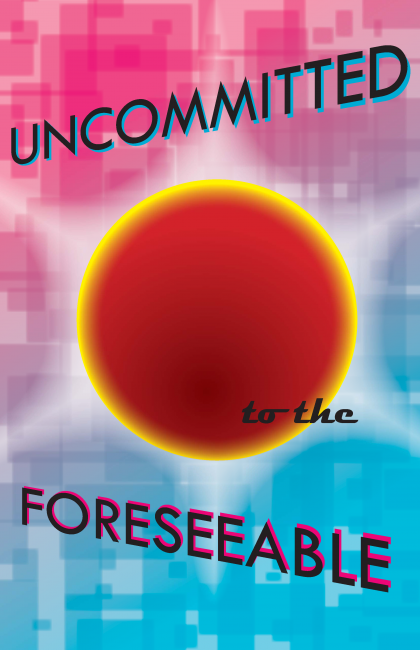
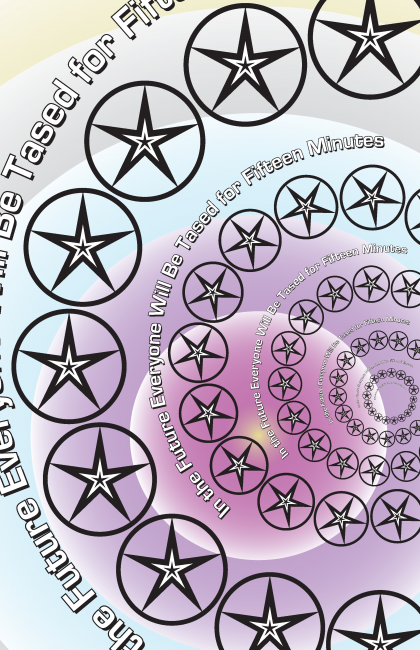
Well, I think it’s safe to say that doing these posters is some of the most satisfying work I’ve been up to lately. So satisfying, that I’m running out of Twitter-quips to turn into posters. If you’d like to compose something witty and succinct, hit me up @interdome, and maybe if you sound as self-satisfyingly sardonic as me, I’ll immortalize you in a poster.
Today’s poster is inspired by @djrupture, who hasn’t been tweeting as much lately, but if he starts doing his breakfast posts again, then I will most definitely have to do a breakfast poster. “Breakfast posters”: the future of digital print. Forget direct mail. Breakfast is where it’s at. You heard it here first.
Now, I am not the major Terminator fan that is nailing his ass to the wall. Well, at least not exactly. You see, I am not a fan of the Terminator, that is to say the T-800: not even as an anti-hero. What I am a fan of, is the film, The Terminator.
And this is the ambiguous technicality on which I will make my case. Not the technicality that Jonah Campbell mentions in his footnote–that in fact, yes, there is dialog in the film explicitly referring to the T-800 as a cyborg. I am referring to the film itself–the film, The Terminator, is a cyborg. This is the ambiguous part.
Because, a film is not a cyborg any more than the character of the T-800 is a cyborg. In the same way that the T-800 is not so much a classic cyborg as it is a special effect, a movie melange of various horror themes involving technology and human mortality, as Campbell describes, it would be disingenuous and perhaps a pretentious stretch to claim that a work of culture is such a cybernetic feedback system.
But I am a dealer in post-structuralism, and disingenuous and pretentious are two of our main product lines. So here goes.
There are two features of any film. (There may be more, but let’s start here.) There is the plot, or narrative of the story being told, and there is the aesthetic form of the film. One might isolate these into content and form, but I wouldn’t go so far as that. I only separate these two aspects at all, by means of their function for delivering the culture-item itself to the viewer. Film excels at delivering this distinction. There is a quality of film, which I could delve into in a whole other essay, that still attracts the eye, and pulls it in to its artistry, even without the smooth sugar of plot to help it down. Perhaps it is in the timeline of film, the fact that film will progress even without a story. Or maybe it is the moving, visual quality that attracts the attention. I see this most explicitly in Eastern European and Russian film. Tarkovsky, Vertov, Tarr. The ability to just look, without saying anything.
Even Western blockbusters and spine-tugging B-movies still tap into this feature of the media. Horror films, by the fact of hackneyed and predictable plot rendering its narrative aspect practically moot, let the image and spectacle of violence, music, and anxiety build to avant-garde levels. This is the way we are introduced to The Terminator–as another sci-fi afternoon at the movies. An unbeatable villian, from a future where all is war. He guns down cops without a thought. And he will not stop until he kills one particular woman.
But there is more to the film than meets the eye, and it is not just the red eye of a machine burning beneath a suit of flesh. There are little tidbits scattered throughout the film. These are small things–little bits of aesthetic that could be easily missed in the pulse-pounding chases and the furious suspense and the eventual violent release. But while your endocrine system is responding to the plot, your aesthetic systems are responding to these small elements. The naked male body of a body-builder, triangulated between a vitrivian man, steroid experiment, and zeitgeist politician. Punks on the edge of society, receiving their just comeuppance, or meeting their (no) future? A female sex object, that will not take off her headphones, even during sex. A motor scooter–the closest we’ve come to a jet pack in the automobile age. Exotic reptiles, kept as pets. Breaking a date on a friday night. A joke, in the form of an answering machine message–”machines need love too.” Cops addicted to nicotine and caffeine. Targets assassinated according to their order in a phone directory. The announcement of one’s own death delivered live over broadcast TV. Los Angeles, home of Hollywood, Blade Runner, dystopic future prison-states and other natural wastelands. Vehicles and weapons, interchangeable, dumped as soon as they cease to function. A synth soundtrack–the fusion of futurism and current culture, an entire history to itself. A bar called Tech-noir. Dogs as man’s best friend, and machine’s worst enemy. Mutilation without pain. Killing sprees. Fast speeds. Robots as toys. Robots as manufacturing workers. Robots as distractions. Robots meant for killing robots. And a Polaroid camera: an image, an emotion, and entire life developed in the briefest of market transactions that will become a key piece of history, to those who will live to see it.
I could delve into each of these images and themes (and boy would I love to, if anyone read 10,000 word articles on the Internet), and unpack and interpret them and their cybernetic connotations for our culture. But, sticking to the post-structuralist promise, I will keep it meta. Each of these images is a cultural mechanism. A feedback loop in celluloid, plugged into our brains. Written in the programming language of Hollywood, Year 1984 AD. Together they form a cybernetic system, regulating the functioning of our aesthetic being, expressing a particular continuity through our emotions of fear, paranoia, and desire. Paranoia of a machine-man is a cyborg reaction. Paying admission to collective horror at simulated violence on a projected light screen is a cybernetic affect. Dancing in a dark, dirty dance club is a feedback loop. Falling in love at the end of the world is the expression of a pattern. Reading the coded messages in a film as part of the experience of viewing a film is culture, and our culture is part of a system, and the programming therein makes one B-movie into a film that defines not only part of an era, but part of us.
So, it is still perhaps disingenuous for me to say that The Terminator is a cyborg, if I am also going to argue that our entire culture of expressive media and consumption of that media is part of a cybernetic structure. But it is. Our notion of what cyborgs are, and aren’t, and what this might mean for our bodily integrity, our history/future, and our entertainment on a Saturday night, serve to prove the point, not only of cybernetic systems, but also of ourselves. We are the emotions we experience at the movies. What we want to show each other, what we want to see, and what we want to feel, is ourselves. Around and around again, always adjusting, always re-orienting, never quitting, as long as we’re alive.
In the end, we are cyborgs, starring with red eyes into a dirty mirror, and using a scalpel to pull a bloody bit of ourselves out, so that we can watch it fall into the water, and scare ourselves to death.
And we’re back with another Motivational Poster, this one completely without the courtesy or permission of @dcurtisj. Not to say he wouldn’t be courteous if asked–I just didn’t ask.
Love this slogan. M and I laughed about it for a long, tasing fifteen minutes. She tried to roll it out at work, but they weren’t having it. Too bad. No one can escape the future, so you might as well learn to like it. Hopefully this poster will motivate you for that.
This one has a lot to like. A symbol, ready for branding a tased future, pastel colors, and enough repetitive circles to make you puke. Which is a good thing, because if you’re puking, you are more likely to survive being tased. Really. There is scientific evidence to back this up.
The Land of Nod Recalls Toy Vegetables Due to Laceration Hazard – The metal wire in the toy asparagus can become exposed, posing a laceration hazard to children. The firm has received a report of an exposed wire in the asparagus. No injuries have been reported.
Microfiction 9/8/10
Haven’t eaten anything since they put wires in my food. Five days ago. Starvation is beginning to affect me. Mentally. Physically, I felt weak and unbalanced by day two. Now my mind is working slower. More animal-like. Needs visualized using only the nerves in my spinal column. Hunger has stopped taking a form of a want, and is an stitch in the torso. Throb in the kidneys. Soreness in the arms, where the muscle is dissolving.
Better than wires in me.
I could inspect the food, go back to the store with wire in hand, making a lot of noise about a free replacement asparagus, double-cheeseburger-hold-the-wire. I know better. They get in eventually. Matter of time. Can try to prevent them, but I’m destined to be wired. It’s the way that it is.
Been thinking, last few hours, maybe it won’t be so bad. Maybe you should just let ‘em win, Johnny. If it’s inevitable, why not? Never been a fighter. That’s why they go with wires. Fighters don’t get wired. Get killed outright, dragged to the streets, heads on lamp posts and built into walls. So who am I, other than a future human prawn, dangling on the end of the wire? Why be anything else? Shrink myself into skin, animal madness, cornered in the alley. Is that life? What is it?
They’re in my skin now, oh boy. Can see ‘em snaking in my veins. Never quite made it to animal, I guess. Wired now. No more asparagus for me.
Air-raid alarms now frequent enough, and lasting long enough, for people habitually to forget whether the alarm is on at the moment, or whether the All Clear has sounded. Noise of bombs and gunfire, except when very close (which probably means within two miles) now accepted as a normal background to sleep or conversation. I have still not heard a bomb go off with the sort of bang that makes you feel you are personally involved.
In Churchill’s speech, number killed in air-raids during August given as 1075. Even if truthful, probably a large understatement as it includes only civilian casualties. . . . . The secretiveness officially practised about raids is extraordinary. To-day’s papers report that a bomb fell in a square “in central London”. Impossible to find out which square it was, though thousands of people must know.
We are (atemporally) in the middle of the Battle of Britain with George Orwell, post-sixty years. And we are amazed, not that there is a lack of information other than the disinformation posted in the papers. Anyone ever in an evolving crisis situation will know that reliable information is few and far between. But we are amazed, when we think that in our current time, these sorts of emergencies are dropping off. Out of the swirling mists on unknowing, looming cliffs are appearing all the time.
Could a bomb explode in the middle of a city, and no one know where? The information would be immediate and distributed, multifaceted, with pictures, words, and video. The video guns would be firing left and right, feeding reverse ammunition to the armies standing behind them. There are still places where cell phones are difficult to come by, and places where first-world Internet-interest fails to reach. But these guerrilla attacks of insipid truth-noise are exploding all over the planet.
It’s good and bad, but mostly, it is categorically different. There are very few things about technology that are truly different. Human-technology, that is to say bodies and minds, is largely the same, despite a thousand cyborgs limbs having bloomed. A human with a stone ax and a hand gun behave relatively the same. Humanity is reliably getting as drunk as they ever have done on their technology, even if the alcoholic content of beer has lately been increasing. Still dances from the hips, still kisses with saliva. And yet this is different, because it is a door that has closed, or a window that has opened.
What will change if a government cannot drop a bomb on a square in central London, and another government cannot hide this fact from its people? Who knows, maybe nothing. It hasn’t stopped people from bombing things, that’s for sure. But there is a difference. Maybe noticing the difference is the change itself.
I was enjoying it, until I scrolled down the text of the poem, and was irrevocably distracted from the text–which is a bit more challenging than the typical web browsing fare–by a glaring embedded Flash ad, shouting moving text at my face, in different colors and fonts to boot.
The Ad was for The Atlantic.
At some point, if they wish to consider themselves curators and not simply link-toilet pipes lined with ads, online publications and periodicals are going to have to rethink the efficacy of the standard model of online advertising.
I know this is a bad time. Venerable publications, such as the Atlantic, who “after 150 years of publishing, know a thing or two” as their ad reminded me, are distracted by the mortal problem of how to stay in financial existence in this new literary age, and so the minor points of CSS and ad placement probably fell low on the list of immediate importance. I would also excuse them the irony of having it be a squirming piece of self-advertisement, because the circulation of ads throughout a site is often at random, and had I loaded the page at a different moment, I might have seen a less-innocuous ad for a poetry collection, or a non-profit, or something else. Although, the fact that it was an ad for their own publication displaces the first mitigating factor, in that the ad clearly wasn’t generating much needed revenue for them.
But all of these details aside, this is a problem that must be solved. And it will be, eventually. I don’t believe that the combined traditions of literature throughout the culture of the human species is going to die off because of ebooks, or web ads, or poorly designed internet magazines. If we lose our capacity for literature, it will be because we as a species will have lost it as we evolve towards being a non-literary animal–or de-evolve, depending on how you look at it. It will not be that technology made us do it; it will be that our literature allowed technology to do it. And because of this, and because I don’t think we’re going to lose our literary aspects any time soon, I can comfortably say that the format for web publishing WILL change. Because this cannot be the way that it is. People like Coates will continue to love Williams Carlos Williams, and continue to use the Internet to share this love. But the Flash ads cannot and will not stay. These ads will be shed from the margins of literature, like water off a duck. The two are simply not co-existent with each other, and between the two, literature is the one with a deeper emotional root. Flash ads will be evicted from the flanks of literature, pulled off like a lamprey and squeezed like a tick, driven back to the literary exurbs among music videos and cat pics, where they belong. And no one will be sorry.
The reason I say this, is to plead with the web editors of The Atlantic. Reject embedded Flash Ads now. Think about your curation. Because that, presenting literature as literature, is what you are supposedly doing. You are responsible for adapting the literary glands of humanity to this new technological thing we have invented. We can clearly see that Flash ads have no place as buttresses for literature, so take action now, and be the first to expel them from our poetry-loving sight. Flash ads are snap bracelets. They are tamagotchi. They are the current thing that everyone has, so grocery and dollar stores are stocking tons of cheap knock-offs to try and make a quick buck. Cheap knock-offs that cut your wrists with rusty, elastic metal bands that have ripped through their neon plastic coating and have to be recalled. The stores that stock this trash do not have a business model. Their model is they sell anything people will take off the shelves, and get throw out what they won’t. This is not curation. This isn’t even the fine art of desire-marketing, the age-old industry of pornography and prostitution. This is offering to sell someone your shoes because they said they liked them.
Remember that you have a product, and that is words. Remember you have a form, and that is literature. This will be the content and the form for as long as there are people around to read it. Define the words you publish by the way they are presented, because this is how and why people will come to consume them. If you have to advertise, then advertise. But don’t let the advertising fuck with your message. Because then advertising has become the message, and this message is shining in your face like a five year old with a flashlight.
Embedded Flash ads will go the way of the animated gif. Make no mistake. So get your literature out now, and early. Those whom you curate for will thank you.
Another motivational poster, though not from Twitter, this time. M, my partner, just read The Ask by Sam Lipsyte, which she enjoyed. She also enjoyed my other posters, and so she asked me to design a poster around the text above, which she thought was a hilarious line from the book. That’s the line, as near verbatim as she can remember. I don’t normally do requests, but she gets that privilege. Though let’s be honest: if someone had a request, I’d probably do it (if I could think of something.)
InDesign practice-wise, the logos were the easy part. Doing the speech bubbles took forever, trying to shape all those tiny curves. Anyone know of a preference setting so that the Zoom hotkeys will zoom on the current view, not on the selected object? If you do, let me know over Twitter, or something. (@interdome.) Was getting car sick from scrolling around.
So now she has this lovely poster to grace her bedroom door. I struggled with this one for a bit, until I hit upon the icon theme. It ends up fitting nicely with the “motivational” qualities of the rest of the series. We’re thinking of surreptitiously hanging these up and grocery stores. You could think of it as a guerrilla art campaign to “Ban the Bag”, or we could just be jerks. Either one is really fine.
If you are as tickled by it as she is, even though you are not my partner in the eyes of the State and therefore required to act with at least brief bemusement as required by law, you can download the full PDF here.